Sorry it's bit a while since I've updated this blog. I try to write about things that interest me or things that are an event in my life that I'd like to keep a record of - preserving a great deal of my thoughts and memories for the ages. Unfortunately, for the last few weeks and months I've been in a weird state. I've been unable to transcribe what I wanted to write into words. In fact, as I type this, there are several posts sitting, unfinished as I suffered a block. I'm going to have another go now with a post about nostalgia.
In early January, the BBC showed a series of programs looking at the last decade and investigating the trends that emerged. One of the major trends was a reluctance of people to grow up and their desire to cling to their childhoods. Certainly nostalgia has become a big business as companies realise that money can be made from this desire. Weirdly this seemed to coincide with my time as an undergraduate. It always seems that trends have followed what I'm interested in. It may be that most of the time, it's in fact me following trends, but this time it definitely seemed the market trend followed on from my thoughts. Anyway, it's apparently commonplace to reminisce about your childhoods at university - it makes sense as everyone is roughly the same age so their pop-culture memories are likely to be the same. My friends and I talked about toys we used to play with and television shows we used to watch. Films aren't really included as they were available on video or on TV again and again. The real nostalgia-inducers were TV shows. In 1999, DVD hadn't taken off and was still expensive and there were very few TV VHS sets. Naturally we got talking about shows such as the A-Team, Knightrider and ThunderCats and other shows from the 80s. We even went so far as to set up a college society: Trevelyan Alternative Movie Plus Animated Cartoon Society (TAMPACS). At this point in history, several things were about to happen that would explode this nostalgia out of college rooms and into the mainstream. The first was the gradual rise of DVD. With it's simplified manufacturing procedure, the costs would rapidly fall so entire runs of TV shows became affordable. The second was the internet. For the first time, people could virtually gather in chatrooms and forums to reminisce and people began converting old VHS recordings into digital video and slowly, in this still pre-YouTube age of dial-up internet, it became possible to hear the opening and closing themes and even see the opening and closing titles of all those half-remembered childhood favourites. This was a chance to post your half-remembered parts of a forgotten show and Over the next few years there was an explosion of 80s tv shows released onto DVD riding the nostalgia wave. It wasn't just tv shows that enjoyed this collective desire to relive the past - retro gaming became big as a whole heap of 80s and 90s games came back onto the market in the various virtual console stores and retro compilation sets.
This is where the second part of this post comes in - how this nostalgia affects us. Most of these retro things such as forgotten TV shows, primitive video games and even music are from fairly sharply defined parts of our past. A further good example of this is magazines. In today's world, we have the internet with it's up to the minute news and information from around the world. However, back in the 90s I got most of my information about things I liked from magazines that, by their nature were out of date by the time they hit the news stands. I used to read a couple of console magazines religiously for about 4 years or so: Mean Machines (which became Nintendo Magazine System) and SuperPlay. They were published monthly and I used to read them from cover to cover, even if certain games didn't appeal to me. Although I still have the physical copies of these magazines, they have long since been boxed up in the attic. However, there is a Mean Machines archive and over Christmas I found a torrent for a complete set of SuperPlay scans. Reading back through these magazines gave me shots of pure nostalgia - and not just of reading the magazine, but memories of what was going on at that time. And it's occasionally some really random things that my mind has associated with these things. For example, when I see the November 1991 issue of Mean Machines, it really reminds me of the day I went to buy the magazine. I can picture walking into town (despite the fact that I have walked that same route thousands of times, I can still remember that day, for no particular reason) and buying it. It had the Megadrive game F22 Interceptor featured on the cover and came with a free model of MM editor Julian Rignall. I remember getting home and flicking through the magazine while I watched an episode of Star Trek: TNG. I can't remember what episode it was but I'd know it if I saw it again. Similarly, the issues of MM and SP I took with me to India are burned into my mind as they were all I had to entertain me over the weeks we were there. Moving on to TV shows, when I was about 9 or 10 there was a repeat of a show called Star Fleet on ITV every Saturday over lunchtime. I remember seeing it for the first time and going outside to play in the garden afterwards - it was when we still had a small rose tree on the small lawn. For months after that, I would try to make Lego models of the X-bomber and other ships from the show. Both times I remember it airing, I had the same problem - it finished its run when we were in India and our rubbish video could only record for two weeks (and it failed to do that most of the time!) so I never saw the end of the story. This would have been in 1990 at the latest. As the years passed by I forgot about Star Fleet, but eventually it came back to me at university and, thanks to the internet, I found the themes, intro videos and eventually the full series and all these memories came flooding back. In fact when I ordered the series as a series of VHS rips, when it arrived, I watched all 24 episodes in one go - something I'd never done before. Finally a rare example of a film. It was early December 1989 (I was 9) and one Saturday morning I began watching what I thought was a short animation. It started out in a small mining town and involved pirates and the government chasing these kids. Then we were shown a robot that had fallen from the sky which subsequently woke up. Eventually the action moved to a floating island and the pirates turned out to be good guys. It was epic at the time and it completely sucked me in. I didn't see that film again for over ten years. In fact it passed almost out of my memory except for occasionally remembering that sketchy outline, with the robot that fell from the sky being particularly memorable. Finally in 2002, I joined the DVD Forums and got involved in one of those "can you name this film?" threads. It turned out the film was Laputa: Castle in the sky - one on the early Studio Ghibli films. As luck had it the Studio Ghibli collection was in the process of being released in on DVD and within 6 months I had a region 3 DVD of Laputa winging its way to me. Watching it brought back all the memories: later on that Saturday, I went to see Father Christmas at the local village hall (which was odd as we normally went to a department store grotto with school) and I can still remember the small present I was given (a toy car). In fact, I could still pick that car out from all my others.
I've always been someone that can remember small things like this. On several occasions my friends have looked quizzically at me and asked "how do you remember stuff like that?" I don't know if other people experience the same experience when it comes to nostalgia, but I suspect they do. What makes it a completely unique experience from person to person, is that the memories triggered by nostalgia will always be different. Even people who experienced something together will have individual memories about it.
What is different in this day and age, is it's unlikely my story will be repeated - now there is such an abundance of retro and nostalgia businesses that everything from TV shows, to video games seems permanently available - from YouTube, through to DVD boxsets and virtual consoles means peoples' long-forgotten cult memories won't be so long-lost any more!
Thursday, June 03, 2010


Sunday, May 09, 2010
Visual tagging of music and it's manipulations
Something that I've touched on several times is music and what trends I've gone through over the years. What I want to focus on now is how music can affect us, how it binds itself to fragments of our lives and how we can be fairly easily emotionally manipulated by music. There are several links in this post to tracks on Spotify, so if you don't have an account (or got hold of a free account), you'll have to make do with the YouTube links. Of course, all the examples I'm going to give are highly personal as you'd expect. The upshot, aside from maybe discovering some new music, is that these tracks will probably illicit no (or completely different) emotional responses.
Unless you watch a lot of the music channels, music is - by definition - an aural experience. The upshot of this is that when we begin to link music with sights, thoughts and feelings we experienced with the times when we acquainted ourselves with the music. Here are some examples from various points through my life from my Spotify "memories" playlist (in no particular order):
Kent - 400 Slag
(It's Swedish before you start thinking anything else!) From 2006, I first picked up on this song from my beloved Pandora (before the feed to the UK was killed) and the album was the first one I bought as a result of Pandora. It's a long, moody intro and the singer has a really smooth voice which is a bit melancholic. The fact that the song is in Swedish means that you really focus on the melody - especially the sweeping choruses. While it's not the best song on the album, it's a song that takes my mind back to 2006 and sitting in my room in House 3 at Trevs. I think the best way to describe that entire year would be nihilistic: I feel I was living without purpose. What should have been a really fun and exciting year just past me by. While the song perhaps sets a depressing picture, I don't really see it as such - just as an aural passport back to that ridiculous room right next to the boiler (which never turned off).
T'Pau - China in your hand
Obviously this is an old one. When I was younger, I went to a swimming club on Thursdays. I was quite good at swimming, especially breaststroke, but I just wasn't competitive. Also, I lacked stamina and I found myself always struggling by the end of the sessions. I didn't know anyone else that went, so combined with my crippling shyness, I didn't have any friends there either. I also found some of the exercises (such as backstroke leg-kicks) fairly claustrophobic (I guess cos I could see where I was going and my ears were underwater meaning I couldn't hear anything and I felt disoriented). All this meant I really didn't look forward to going at all. The session began at 7.30 which meant I just had time to see who was number one of Top of the Pops before I had to go. I guess T'Pau was one of the most catchy tracks from that era and the two things are linked.
Radiohead - Lucky
At this point in my life, I still cling to the belief that the best album I have ever heard is OK computer by Radiohead. To my mind no other album went on such a journey from the raucous, confused and fuzzy opening of Airbag through to the chilled out, lethargic The Tourist. It could be argued that perhaps 2007's In Rainbows finally surpassed it, but being a guitar fan, I think OK Computer still just about stands out as their best for me. Now, the year was2007 1997 (oh dear, that's a long time ago now!), and several of my friends who were into Radiohead were really excited about the release of OK Computer. Obviously at the time I was very impressionable and I immediately looked to see if any of my compilations had any of their songs as I wasn't familiar with them at all. I found that I had a CD with the track Just. It was a song that I'd skipped in the past as it was an immediate song. In fact, the intro to Just is a very confusing and intimidating beginning to a song. It seems strange now to say that a song intimidated me, but it did. I began to be intrigued by their style. Radiohead seem to be a very polarising band. In 1997, even more so. People either loved them or hated them. Thom Yorke's vocal style is very distinct and can take getting used to. After hearing Paranoid Android (the lead single from OK Computer) for the first time - and not being overly familiar with the band - it left me a bit cold, but there was something about the song nagging at me to go back to it. As OK Computer was released, Woolworths did it and The Bends for £20. I snapped them both up and set about listening to them. A week later I went on a family holiday to Rhodes which involved a night flight and arriving very early in the morning. The song that has perhaps the most immediacy is Lucky. It's a very desolate song, with the constant ringing of the guitar strings heard in the intro carrying on in the background all the way through the song almost like crickets. The tremelo effect of the lead guitar coming in and out throughout in the background and the choral synthesiser effects and backing vocals in the chorus all add to create a unique audio landscape. Travelling by bus across Rhodes from the airport at 5 am, I had my walkman playing this song when I peered through the curtains and saw a desolate rocky, barren desert outside. The view just perfectly fit with the music and this link has stayed in my mind ever since.
Hans Zimmer - Like a dog chasing cars
Back to 2008 and the release of The Dark Knight. I'd really enjoyed Batman Begins in 2005 as a great example of how far comic book movies had come in the last 10-15 years. Gotham was now a believable, gritty, crime-ridden city rather than the pantomime neon or overly Gothic creations seen before. Rumours were that The Dark Knight was even better but nothing could have prepared me for it. We drove down to Bradford to see the film at the IMAX screen. It was a pretty horrid day by the time we got there - overcast, raining and cold. The weather fit completely with the tone of the film. It was epic. Constantly tense, the music served to alternate between the schizophrenic, tension of the strings which marked out the Joker's presence, to the bursts of heroic theme which quickly transitioned back to a tension-raising version. By two thirds of the way through the film I felt completely emotionally drained. If anything, the film was too much to take in. This track I've chosen will always remind me of sitting in that cinema and being so overwhelmed with what was happening and the feelings carried over with me for days and are retained on repeat viewings.
Moby - Look back in
At the end of my 3rd year at Durham I felt quite depressed. The majority of my friends had finished their degrees and I knew the next year would be a very different experience. During that summer I began to rediscover some albums by listening to them in the dark. I suddenly found that effectively shutting off my visual inputs left me free to concentrate more on the music and let my mind wander to wherever the music took it. This short track from the album 18 was the one track that summed up this very reflective period in my life. It's very short at under 3 minutes in length, but has a dreamlike quality to it. The title - Look back in - captured how it made me feel: looking back over the last three years. I just wish it was a little longer. A lot of people didn't like the album 18 as they felt it was simply a poor rehash of Play, but there are a lot of really nice chilled out tracks such as One of these mornings and In this world.
So there you have it - some really wide ranging examples of a small selection of music that instantly transports me somewhere in my mind. I'm sure everyone has their own examples and I encourage you to think about them and use a service like Spotify to create playlists of them to send some emotional, nostalgic chills down your spine.
Of course, people know that music can act in this way and seek to take advantage of it. The obvious example is with soundtracks. As with my Dark Knight example, music can emphasise the impact of the moving pictures. It's hard to do, but try and find a dramatic scene from a film or show with and without the backing music and often it won't have the same impact without the music. Obviously, here the music is tailored specifically for the scene and scored to maximise any points or moments the director desires. A slightly less unique approach is that employed by advertisers. They know that music has the power to get straight through the logical part of your brain and wedge itself straight in the emotional part, which is exactly what they want so you don't question exactly why you need a new *thing* - you just want it! Often times, simplified, cut down arrangements can often get through to people. A good example of this is the John Lewis Christmas campaigns. Here are the 2008 and 2009 adverts
Both feature stripped back versions of famous songs. The irony is that the Sweet Child Of Mine cover was released as a single, but didn't actually work as a song as it's far too dull an arrangement to sustain interest beyond the runtime of the advert. The piano is one of the best solo instruments to achieve this effect of conjuring up the required emotion. I'll finish this off with a piano arrangement of a suite of music from one of my favourite films, Laputa: Castle in the Sky. Regular readers may remember that this film features large portions of silence, which Disney didn't think Western audiences would be comfortable with, so they actually commissioned the original composer to re-score these previously silent passages when the film came to be released in the West!
Unless you watch a lot of the music channels, music is - by definition - an aural experience. The upshot of this is that when we begin to link music with sights, thoughts and feelings we experienced with the times when we acquainted ourselves with the music. Here are some examples from various points through my life from my Spotify "memories" playlist (in no particular order):
Kent - 400 Slag
(It's Swedish before you start thinking anything else!) From 2006, I first picked up on this song from my beloved Pandora (before the feed to the UK was killed) and the album was the first one I bought as a result of Pandora. It's a long, moody intro and the singer has a really smooth voice which is a bit melancholic. The fact that the song is in Swedish means that you really focus on the melody - especially the sweeping choruses. While it's not the best song on the album, it's a song that takes my mind back to 2006 and sitting in my room in House 3 at Trevs. I think the best way to describe that entire year would be nihilistic: I feel I was living without purpose. What should have been a really fun and exciting year just past me by. While the song perhaps sets a depressing picture, I don't really see it as such - just as an aural passport back to that ridiculous room right next to the boiler (which never turned off).
T'Pau - China in your hand
Obviously this is an old one. When I was younger, I went to a swimming club on Thursdays. I was quite good at swimming, especially breaststroke, but I just wasn't competitive. Also, I lacked stamina and I found myself always struggling by the end of the sessions. I didn't know anyone else that went, so combined with my crippling shyness, I didn't have any friends there either. I also found some of the exercises (such as backstroke leg-kicks) fairly claustrophobic (I guess cos I could see where I was going and my ears were underwater meaning I couldn't hear anything and I felt disoriented). All this meant I really didn't look forward to going at all. The session began at 7.30 which meant I just had time to see who was number one of Top of the Pops before I had to go. I guess T'Pau was one of the most catchy tracks from that era and the two things are linked.
Radiohead - Lucky
At this point in my life, I still cling to the belief that the best album I have ever heard is OK computer by Radiohead. To my mind no other album went on such a journey from the raucous, confused and fuzzy opening of Airbag through to the chilled out, lethargic The Tourist. It could be argued that perhaps 2007's In Rainbows finally surpassed it, but being a guitar fan, I think OK Computer still just about stands out as their best for me. Now, the year was
Hans Zimmer - Like a dog chasing cars
Back to 2008 and the release of The Dark Knight. I'd really enjoyed Batman Begins in 2005 as a great example of how far comic book movies had come in the last 10-15 years. Gotham was now a believable, gritty, crime-ridden city rather than the pantomime neon or overly Gothic creations seen before. Rumours were that The Dark Knight was even better but nothing could have prepared me for it. We drove down to Bradford to see the film at the IMAX screen. It was a pretty horrid day by the time we got there - overcast, raining and cold. The weather fit completely with the tone of the film. It was epic. Constantly tense, the music served to alternate between the schizophrenic, tension of the strings which marked out the Joker's presence, to the bursts of heroic theme which quickly transitioned back to a tension-raising version. By two thirds of the way through the film I felt completely emotionally drained. If anything, the film was too much to take in. This track I've chosen will always remind me of sitting in that cinema and being so overwhelmed with what was happening and the feelings carried over with me for days and are retained on repeat viewings.
Moby - Look back in
At the end of my 3rd year at Durham I felt quite depressed. The majority of my friends had finished their degrees and I knew the next year would be a very different experience. During that summer I began to rediscover some albums by listening to them in the dark. I suddenly found that effectively shutting off my visual inputs left me free to concentrate more on the music and let my mind wander to wherever the music took it. This short track from the album 18 was the one track that summed up this very reflective period in my life. It's very short at under 3 minutes in length, but has a dreamlike quality to it. The title - Look back in - captured how it made me feel: looking back over the last three years. I just wish it was a little longer. A lot of people didn't like the album 18 as they felt it was simply a poor rehash of Play, but there are a lot of really nice chilled out tracks such as One of these mornings and In this world.
So there you have it - some really wide ranging examples of a small selection of music that instantly transports me somewhere in my mind. I'm sure everyone has their own examples and I encourage you to think about them and use a service like Spotify to create playlists of them to send some emotional, nostalgic chills down your spine.
Of course, people know that music can act in this way and seek to take advantage of it. The obvious example is with soundtracks. As with my Dark Knight example, music can emphasise the impact of the moving pictures. It's hard to do, but try and find a dramatic scene from a film or show with and without the backing music and often it won't have the same impact without the music. Obviously, here the music is tailored specifically for the scene and scored to maximise any points or moments the director desires. A slightly less unique approach is that employed by advertisers. They know that music has the power to get straight through the logical part of your brain and wedge itself straight in the emotional part, which is exactly what they want so you don't question exactly why you need a new *thing* - you just want it! Often times, simplified, cut down arrangements can often get through to people. A good example of this is the John Lewis Christmas campaigns. Here are the 2008 and 2009 adverts
Both feature stripped back versions of famous songs. The irony is that the Sweet Child Of Mine cover was released as a single, but didn't actually work as a song as it's far too dull an arrangement to sustain interest beyond the runtime of the advert. The piano is one of the best solo instruments to achieve this effect of conjuring up the required emotion. I'll finish this off with a piano arrangement of a suite of music from one of my favourite films, Laputa: Castle in the Sky. Regular readers may remember that this film features large portions of silence, which Disney didn't think Western audiences would be comfortable with, so they actually commissioned the original composer to re-score these previously silent passages when the film came to be released in the West!
Thursday, April 22, 2010
All change
So. After ten years (with a nine month break in the middle) I'm finally leaving Durham. No, I've finally left Durham. How did this happen? Where am I now? Let me explain. For the past 2 years and 9 months I've been employed by Thorn Lighting and their parent company Zumtobel. The employment was on a fixed contract for the duration of the TOPLESS project (a 3 year project to develop white light-emitting polymer materials for lighting applications). Until Christmas last year I wasn't really thinking about the end of my contract. I was vaguely confident that more money would be forthcoming - either from Thorn or from Durham University to continue our promising work in the field of high-triplet hosts and novel soluble blue phosphorescent emitters. However, no such money materialised and although it looks like a Thorn-led follow-up to TOPLESS will gain public funding, it will most likely be mostly engineering-based with the chemistry/materials development handled outside the project. This situation meant that all the Durham-based workers (a total of 5) were facing the dole. Thankfully just about everyone manage to find alternate employment. I was fortunate that a job opened up at CDT in January and this time, after a 4 hour interview (with no breaks!) I was offered the job (3rd time's the charm). Of course this meant I was suddenly facing 3 weeks until I was due to start in Cambridge. This meant I had to tie up (or try to tie up) and hand over my work in Durham (i.e. lumping it onto other chemists), find somewhere to live in an unfamiliar city, pack up and move south. In the end I got a lucky break with packing the stuff up as we were able to negotiate a much cheaper extra months extension to our rent. This means I've still got a lot of stuff up in Durham for now.
It was pretty surreal packing up and coming home for Easter as it felt just like any other Easter, but I wouldn't be going back north to Durham, but east to Cambridge. Finding somewhere to live was interesting as Cambridge seems to be a city full of shared houses where you rent rooms rather than finding a flat between a few of you. This is in complete contrast to Durham where the onus is on renting out complete properties. Anyway I found a nice laid back house just off Chesterton Road which is a nice 35 minutes walk to work and 15 minute walk to the town centre. Hopefully these numbers will drop substantially once I bring my bike from home (assuming it hasn't fallen apart).
Having been in Durham for so long (and 6 years in the same lab/department) going into CDT was a complete change. Bigger fumehoods, different protocols, not knowing where anything is or how to submit samples for analysis. And this is just the chemistry - the meetings are a blur of acronyms - even for someone with 6 years OLED experience it's been a struggle to adapt, but I'm getting the hang of it. The work load started off light and has now ramped up to a level I'm still comfortable with - several targets and regular meetings/updates and polymers to be made. It's hard to believe I've just finished my third week. There are several other new starters on the chemistry side and there will likely be a few more in the next few months, but even so the company (at least the Cambridge office) is a lot smaller than I realised. This is mainly down to a lack of physical space of both desks and lab space. Everyone's really friendly and helpful and I'm sure before long I'll feel like I've been there for years.
Cambridge is really nice (it helps that I've arrived just as the weather is getting warmer). The tourists can be a bit much, but they tend to congregate around the town centre and the colleges in particular where everything is pedestrianised so it never feels too cramped. I haven't been punting yet, but I'm assured there will be company trips down the river to Grantchester over the summer and some evening punting sessions. I've just about figured out how to navigate around the different parts of the city (Google maps helps a lot), now I just have to remember where everything is!
I guess it still hasn't really sunk in that I've left Durham - it's all happened so quickly. I really miss everyone there and hopefully I'll be able to go back up for some weekends to see everyone and find out how they're all doing. It's always interesting to see how people get on when you leave - most of the time they don't even notice after a few weeks!
Anyway, my job is a permanent position (unless it turns out that I'm rubbish and get fired!) so hopefully there shouldn't be any more sudden changes unless I instigate them. And finally I have a pension (how grown up). The dental insurance means I might actually see a dentist for the first time in ages and I have the option of private health care too. Not too shabby.
Hopefully I'll start to feel the photography vibe again in my new surroundings which will enable to post some pictures of my new surroundings.
It's also a bit weird without most of my gadgets - my TV and other AV stuff will likely spend the next few months at my parents and once again I am living the minimalist lifestyle.
Anyway - till next time (and I'll try and update a bit more often!)
Sunday, December 06, 2009
The joys (and pains) of media
Isn't media great? Thankfully it's moved on from the 90s buzz-word of "multimedia". Everything from pictures, music, books, films all the way through to my old undergraduate lecture notes. This is the stuff that can provoke a wide range of emotional responses from nostalgia all the way through to relaxation. In the days of the 20th century all this media came in different forms: photographs, cassettes/CDs, vhs/DVD. In the early days on the 21st century people began converting to digital cameras which freed them from the shackles of being careful what shots to make to conserve film and having to print out (and then store) all their pictures. In the middle of the noughties people began to embrace digital music in the place of physical CDs to the point where the top40 was nearly abolished and many shops stopped selling all but the most popular singles. As we move towards the next decade, there is increased interest in video downloads and ebooks - in fact ebook readers are starting to be rammed down our throats this Christmas, but I can save that for another post. One outcome of this switch from the bulky analogue "physical" formats to the digital domain combined with the increases in codec performance and hard drive size is that people can now store all their media on their computer: full CD collections, a lifetimes photographs, home videos and DVDs. My parents have just bought a document scanner so I now have all my undergraduate notes in pdf format that I can take with me anywhere without needed to lug around the original folders of notes. I've also been able to jettison years of bank and credit card statements too.
I've written about this before in my piece on minimalist lifestyles. In the last few years I set about converting all my precious media into digital form. The majority of my DVDs are now in m4v format and all of my music has been ripped to mp3 (although I have just re-ripped it all to a lossless format for archival purposes). What I haven't really touched on (or thought about until this year) is data security. I was exposed to this in 2001 when my parents PC was stolen during a break-in. All my files (school projects, essays and reviews and emails) were lost. But I was actually quite lucky as that was at the beginning of the digital revolution and I didn't loose too much. I have noticed thought that people don't really think about keeping their media safe, as previously - short of their house burning down - it was fairly safe in physical formats. It's highly unlikely any burglars would be interested in you photo albums but they are interested in the computers that people have entrusted their whole media collections onto. With this goes all the emotional connections their media can trigger. If the computer breaks, is stolen or lost or corrupts all these things are put at risk. It used to be that we were lucky to be able to fit all our music on our computer at ridiculously low bitrates, and now we can fit all our 256 Kbps tracks onto our iPods. There's definitely something very liberating about having your whole music, film, book and photo collection contained on something smaller than a hardback book, but at the same time something that valuable must be fearsomely protected too.
A lot of people will say that hard drives are too expensive, but I would argue that spending a bit of money is a lot better than facing the loss of a media-filled drive. Photos of family, friends and holidays, large collections of emails, music collections and a whole heap of other personal files. I will advise some ways to properly protect your files.
The most obvious way is to simply buy a large external hard drive and copy all your files to it. The trouble with this approach is maintaining this backup as you add and update more media files. Solutions such as Time Machine for Mac offer a good way of keeping an incremental backup (so older versions of files are preserved as well as new ones) or SyncToy for windows (for simple synchronisation of drives) are free solutions. Simply doing this will put you ahead of 90% of people who have no backup at all - a 1 TB USB drive costs about £60-65 at the moment. If you share media between several computers, a NAS (i.e. a hard drive that plugs into your network router) is a good option as anyone on your network can access the files. More expensive models offer two or more drives and offer so-called data redundancy. The idea is that with two (or more) drives, if one drive dies, the data is still on the other one (obviously your storage is equal to the size of the smallest drive) and with three or more drives, the data is spread across them in such a way that any drive failing won't result in a loss of files.
A lot of people rely on these multidisk NAS solutions but it isn't foolproof. If more than one drives dies, or the unit itself dies, or you are robbed or your house burns down you're equally stuffed. Unless you genuinely need more than a couple of terabytes of storage I'd simply recommend a simple NAS such as this one and then also buy a USB drive which you can use to back up the NAS automatically at set periods and then store at another location such as work. To be really thorough, buy 2 USB drives, keep one at home to back up the NAS and one at work changing them over every week or so. This may seem over the top, but for under £250 you can have a secure 1 TB setup (a 1 TB NAS and 2 1 TB USB drives).
The other alternative that probably isn't feasible at the moment for bulk media backups is cloud storage. More and more firms are offering storage space that can be accessed through the internet and backed up using commercial systems. Of course, the downsides to this are a monthly fee for sizeable amounts of storage and the insanely low upload speed most people in the UK see (our "fast" connection offers us 1 Mbps upload compared to 14 Mbps download). For small files (such as documents) I can recommend Dropbox which offers 2 GB of cloud storage for free. Your files can be accessed from any device running dropbox (PCs, Macs, linux, phones).
India Part 3
On our final day in Agra, we took a trip out to Fatehpur Sikri about 30 miles away that is a town founded by a Moghal Emperor and then mysteriously abandoned 15 years later. As our booked taxi driver dropped us off at the foot of the hill, a Rickshaw took us up to the gates of the city. Again we were "compelled" to take a guide with us, and we explored the first few areas of the city. The weather was beautiful and cool and the city serene. That is, until we approached the final section of the city set next to the main road. The area was sprawling with hawkers who followed us round all the way up to the entrance trying to sell us tat. Things didn't improve that much on the inside as a whole different set of hawkers attacked us. As we approached Tomb of Salim Chishti, where you can attach a thread to make a wish we were informed that to make a wish you had to buy a cloth from the hawker (an official person our guide informed us). After picking a purple silk-style handkerchief we were informed that this particular "cloth" would cost us over Rs: 1200 (about £30). Unsurprisingly we passed on this "offer" and even though we were told this was a "very reasonable price" we moved on. Most upsetting for my mother who had come back to untie her thread as her wish (to return to Fatehpur Sikri).

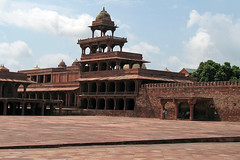
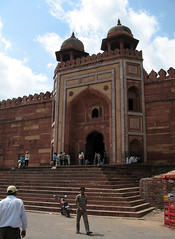


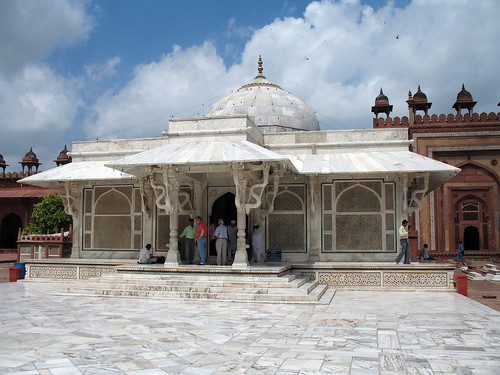
Anyway, with our tour complete we headed back out and down the hill to await our taxi back to Agra. We bundled into the taxi with a different driver and headed back. After about 20 minutes our driver pulled off the main road and into a small restaurant, where he announced that due to union rules he had to have a half hour break. What this essentially meant was that the restaurant we had stopped at was paying our driver a kickback to bring tourists to them. Unfortunately for our driver, who disappeared into a back room, the four of us sat down for half an hour and had one bottle of Pepsi between us. After half an hour (presumably during which time our driver was getting a bollocking for bringing tight-wads to the restaurant) we set off again. Driving past the small shanty towns the amazing thing was the amount of advertising. Nearly every settlement had adverts for Pepsi or Colgate on the sides of the shacks, not papered up like we're familiar with, but painted on. The odds of such products being available in these shanty towns was slim to none. When we got back to the air-conditioned luxury, Emma and I decided to take to the streets and explore Agra by foot. When we reached the hotel gate we were faced with a 50:50 left-right choice. We made the wrong choice. After about a quarter of a mile, the only things we had found were a dead, bloated dog in the drain and a very annoying cycle-rickshaw driver who followed us for about a mile and a half as we doubled back on ourselves and headed the other way. He seemed quite insistent that there was no point walking and that we should pay him to drive us. Eventually we lost him down a narrow side street. The city is basically a sprawl around its cultural sites and there really isn't much else on view bar open sewers and poverty. We caught site of monkeys leaping from roof to roof and views into random bric-a-brac stores and homes. One friendly local approached us for a chat to practise his English, but were relieved to get back to the hotel: as the Wikitravel guide notes: "After getting off the streets of Agra and into your hotel, you won't want to go back anyway."
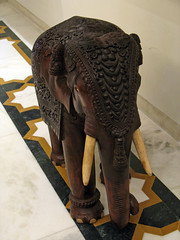
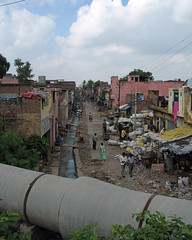

We head back to the station and got the train back to Delhi, which was livened up by some kind of creepy crawly crawling round the carriage. The following day, we headed out for lunch with more relatives I hadn't seen in years - this time a former Indian Ambassador. After lunch we raced back to the airport only to find our flight had been cancelled and we'd been shunted to the next flight.
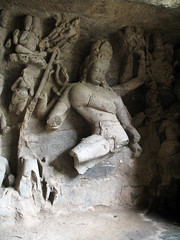
The final week in Bombay consisted of seeing more relatives - some of whom looked very old and some of whom hardly seemed to have changed at all, eating a lot of good food and me getting a tailored suit made and, of course, swimming. Towards the end of the week Emma and I headed into town early to get the boat from the Gateway to Elephanta island - something else we used to do every year. The slow boat chugged out to the island for about an hour and then we walked up the long stairs to the caves where ancient stone carvings of the ancient gods Brahma (the creator), Vishnu (the preserver) and Shiva (the destroyer) which date back to the 9th century and have mostly survived despite the Portuguese using them as target practice in the 17th century. This time after fighting our way through the guides on the way up, we were met by an official guide inside (with a price of Rs 0).

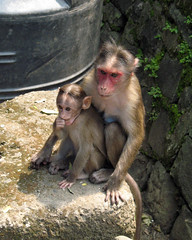
After watching the local monkeys playing for a bit we caught the boat back to the mainland and had lunch at a local Chinese restaurant and an abortive visit the the famous (and now infamous) Taj Mahal hotel.


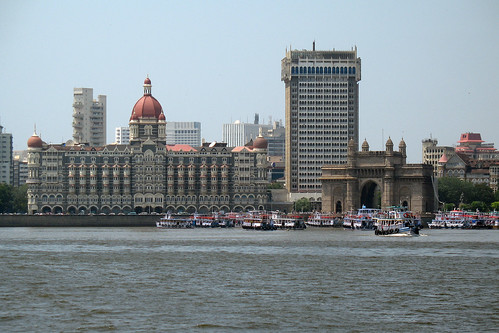
By the end of the week it was finally time for the dinner at the Racecourse to celebrate my Aunt's 70th birthday attended by several of my Aunt and Uncle's friends from the Willingdon club. With such an exclusive history and an even longer waiting list for membership, the club certainly hosts the elite of Mumbai. Finally it was time to head home. The chaos at the airport seemed to be worse than I remember. The airport still operates a policy of only passengers being allowed in the building so the drop-off area is overrun with relatives and queues to get in. This was going to be interesting since we didn't have a ticket (just our e-ticket number). Thankfully, the guard seemed to realise that the big suitcases we had signalled that we were going to be catching a flight and let us in. The terminal is still being "upgraded" and the place was simply a mess. An overrun mess. As in Schiphol on the way out, we all had to be interviewed by US security as we were flying a US airline and then finally, just before midnight we were off.
And that was it. But not quite. I woke up somewhere near Eastern Germany. With only about 90 minutes I assumed we had missed breakfast, but then something didn't seem right as the lights were still down. As we passed central Germany the lights suddenly came on and the flight attendants began serving breakfast. Luckily we were near the front of the queue, but before even half our cabin had even been served, the captain came over the intercom announcing we were beginning our decent into Amsterdam. As we slowed and descended over northern Holland, the stewardesses began saying "Someone should call him!" to each other. Eventually, everybody had been served, but then the captain came back over the intercom to tell the flight crew to take their seats. For a second it looked like we'd be making a landing with our breakfast. Even at the point the cabin crew seemed to think they'd be okay until the wheels came down and one remarked "We're not going to make it!" No kidding. Suddenly the engines roared as full climb throttle was applied and we overshot the runway in a missed approach after someone had presumably told the captain that the economy cabins were still tucking in to breakfast. After circling to allow the consumption, we finally landed at Schiphol. The crew didn't say a word as we filed off. When we arrived back into Birmingham the same weird sound and feeling that I remember from my previous visits came back. The sound was order: no horns blaring, no cars driving inches from where we walked, disciplined (sort of) driving and the feeling was cold. It's almost as much of a system shock returning to the UK after a fortnight in India as it is getting there in the first place!
Anyway, with our tour complete we headed back out and down the hill to await our taxi back to Agra. We bundled into the taxi with a different driver and headed back. After about 20 minutes our driver pulled off the main road and into a small restaurant, where he announced that due to union rules he had to have a half hour break. What this essentially meant was that the restaurant we had stopped at was paying our driver a kickback to bring tourists to them. Unfortunately for our driver, who disappeared into a back room, the four of us sat down for half an hour and had one bottle of Pepsi between us. After half an hour (presumably during which time our driver was getting a bollocking for bringing tight-wads to the restaurant) we set off again. Driving past the small shanty towns the amazing thing was the amount of advertising. Nearly every settlement had adverts for Pepsi or Colgate on the sides of the shacks, not papered up like we're familiar with, but painted on. The odds of such products being available in these shanty towns was slim to none. When we got back to the air-conditioned luxury, Emma and I decided to take to the streets and explore Agra by foot. When we reached the hotel gate we were faced with a 50:50 left-right choice. We made the wrong choice. After about a quarter of a mile, the only things we had found were a dead, bloated dog in the drain and a very annoying cycle-rickshaw driver who followed us for about a mile and a half as we doubled back on ourselves and headed the other way. He seemed quite insistent that there was no point walking and that we should pay him to drive us. Eventually we lost him down a narrow side street. The city is basically a sprawl around its cultural sites and there really isn't much else on view bar open sewers and poverty. We caught site of monkeys leaping from roof to roof and views into random bric-a-brac stores and homes. One friendly local approached us for a chat to practise his English, but were relieved to get back to the hotel: as the Wikitravel guide notes: "After getting off the streets of Agra and into your hotel, you won't want to go back anyway."
We head back to the station and got the train back to Delhi, which was livened up by some kind of creepy crawly crawling round the carriage. The following day, we headed out for lunch with more relatives I hadn't seen in years - this time a former Indian Ambassador. After lunch we raced back to the airport only to find our flight had been cancelled and we'd been shunted to the next flight.
The final week in Bombay consisted of seeing more relatives - some of whom looked very old and some of whom hardly seemed to have changed at all, eating a lot of good food and me getting a tailored suit made and, of course, swimming. Towards the end of the week Emma and I headed into town early to get the boat from the Gateway to Elephanta island - something else we used to do every year. The slow boat chugged out to the island for about an hour and then we walked up the long stairs to the caves where ancient stone carvings of the ancient gods Brahma (the creator), Vishnu (the preserver) and Shiva (the destroyer) which date back to the 9th century and have mostly survived despite the Portuguese using them as target practice in the 17th century. This time after fighting our way through the guides on the way up, we were met by an official guide inside (with a price of Rs 0).
After watching the local monkeys playing for a bit we caught the boat back to the mainland and had lunch at a local Chinese restaurant and an abortive visit the the famous (and now infamous) Taj Mahal hotel.
By the end of the week it was finally time for the dinner at the Racecourse to celebrate my Aunt's 70th birthday attended by several of my Aunt and Uncle's friends from the Willingdon club. With such an exclusive history and an even longer waiting list for membership, the club certainly hosts the elite of Mumbai. Finally it was time to head home. The chaos at the airport seemed to be worse than I remember. The airport still operates a policy of only passengers being allowed in the building so the drop-off area is overrun with relatives and queues to get in. This was going to be interesting since we didn't have a ticket (just our e-ticket number). Thankfully, the guard seemed to realise that the big suitcases we had signalled that we were going to be catching a flight and let us in. The terminal is still being "upgraded" and the place was simply a mess. An overrun mess. As in Schiphol on the way out, we all had to be interviewed by US security as we were flying a US airline and then finally, just before midnight we were off.
And that was it. But not quite. I woke up somewhere near Eastern Germany. With only about 90 minutes I assumed we had missed breakfast, but then something didn't seem right as the lights were still down. As we passed central Germany the lights suddenly came on and the flight attendants began serving breakfast. Luckily we were near the front of the queue, but before even half our cabin had even been served, the captain came over the intercom announcing we were beginning our decent into Amsterdam. As we slowed and descended over northern Holland, the stewardesses began saying "Someone should call him!" to each other. Eventually, everybody had been served, but then the captain came back over the intercom to tell the flight crew to take their seats. For a second it looked like we'd be making a landing with our breakfast. Even at the point the cabin crew seemed to think they'd be okay until the wheels came down and one remarked "We're not going to make it!" No kidding. Suddenly the engines roared as full climb throttle was applied and we overshot the runway in a missed approach after someone had presumably told the captain that the economy cabins were still tucking in to breakfast. After circling to allow the consumption, we finally landed at Schiphol. The crew didn't say a word as we filed off. When we arrived back into Birmingham the same weird sound and feeling that I remember from my previous visits came back. The sound was order: no horns blaring, no cars driving inches from where we walked, disciplined (sort of) driving and the feeling was cold. It's almost as much of a system shock returning to the UK after a fortnight in India as it is getting there in the first place!
Thursday, October 15, 2009
India part 2
We woke up feeling refreshed - if a bit sweaty. The time of year we had visited was the awkward change-over between the humid and wet monsoon and the cooler "winter". We were still in the humid period so had to sleep with the window open and, of course, with a festival going on meant that firecrackers were let off until the early hours. The house certainly hadn't changed in the plumbing department, with the bathing options being a weak dribble of water from a shower head, or a bucket bath. Venturing out into Dadar soon revealed that apart from the flyover that had been built over the circle, nothing much had changed at all. The weird store that seemed to sell everything was still there, the grocery stores were still there. The flower sellers were still there and the beggars were still there. Actually - I'll embellish a bit - the flyover now meant you didn't take your life into your hands (as much) every time you crossed the road. The lack of patience combined with the driving attitude means that if you are half way across a road and the lights turn green, the drivers won't wait for you...
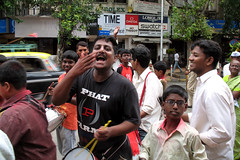

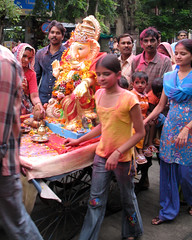
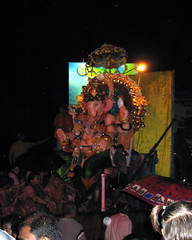
Today was the last day of the Ganpati festival where people took their Ganpatis (idols shaped like Ganesh, the elephant-headed god) and cast them into the sea. This lasted all day with various vans and carts heading towards the sea loaded with clay Ganpatis and whole families. This carried on into the night with bright lights, music and many more firecrackers.

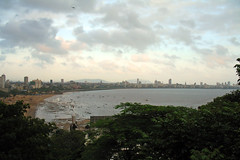
The rest of the week involved getting reacquainted with the city - from the area around the house to downtown. The restaurants, the hanging gardens and Marine Drive and the planetarium (complete with the school tour from hell). Then there was The Club. Every day, my aunt and uncle go to the prestigious Willingdon club where my aunt plays cards and my uncles plays snooker. As a child, we used to go to use the open-air swimming pool. Some years my father actually became a temporary member so we could go more often and children were never allowed in the clubhouse itself. Now I could finally see what all the fuss was about. After a visit to the nearby museum, we arrived for a swim as guests. I haven't swum in years, but it all came back instantly. This time, instead of sitting around the pool afterwards, I was thrilled to finally see the inside of the club. The bar was a modern area with plasma tvs and sweet, sweet air conditioning. Meeting other members of the club reinforces the exclusivity. You may think that a members sports club in a country where many people survive on less than $1 a day would be affordable for a young professional such as myself. I think it's safe to say Emma and I were gob-smacked to find membership cost upwards of £10,000 a year!

One of our tasks for the week was to sort out an excursion. Even though I had been to India many times before, I'd still never been out of the state of Maharashtra. This would change as, combined with the power of the internet and the abundance of low-cost airlines we sorted out a few days in Delhi and Agra.
After experiencing Ryanair, I didn't have high hopes for the Indian variety, but Kingfisher actually puts KLM to shame. New planes, seatback tv screens even on internal flights, good quality food (with metal cutlery) and good crew. Upon arriving in Delhi we were met by our host, my father's nephew Indivar who is an academic at a local university. We piled into his small Tata car and set out across Delhi. After leaving the airport, it immediately became clear that while it was obviously still bonkers, Delhi was a lot less intense and mad than Bombay. The university itself is set in - what to westerners - appears to be a massive amount of wild countryside.

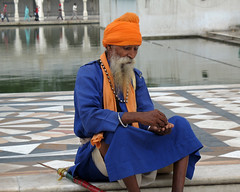
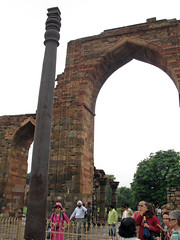
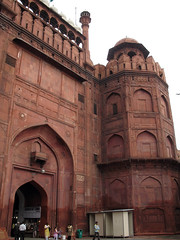
Around Indivar's university-provided accommodation was a family of peacocks, several of which made an appearance. Indivar showed us around the sites, including a Sikh temple and an iron pillar that despite being constructed in 1600-odd years ago hadn't rusted. Sadly, the "magic" reason seems to have been unravelled. We enrolled on an official whistle-stop tour of some sights - including the red fort and Ghandi's tomb that were conducted at break-neck speed.

The trip to Agra would be by train. We had booked first class, but I don't think Emma was ready for what that entailed. As we arrived at the station early in the morning it was already a hive of activity. After finding our platform we discovered it was littered with travellers carrying more baggage that could feasibly fit into the train, hawkers selling their wares and the odd rat running around. As we boarded the train, all thoughts of a western-style first class didn't so much fade from our heads as they were crushed with a mallet. It was like economy on a plane, but without padding on the seats, broken recline mechanisms, tray tables that fell down every five minutes, a lack of A/C and the only entertainment consisted of the sellers that would come through the carriage every so often selling dubious-looking food and drink. After a few hours we arrived in Agra and took a taxi to our hotel for the stay, The Taj hotel. As we entered the hotel, it was like walking into an oasis. Clean white marble, gentle A/C and a good shower. The hotel was called the Taj View and as we reached our room we were happy to discover the hotel lived up to its name.


After an hour or so to enjoy our first decent shower in ten days, we headed back out into the madness and heat to take a rickshaw to the Taj. Rickshaws are awesome fun - it's basically a small moped with a 3-(small) person seat at the back. This means they have the turning circle of a unicycle and combined with the driving discipline meant the we were frequently in danger of falling out as the driver pulled off another ridiculous cornering move.
As we arrived at the drop-off I was amazed that India's best-known tourist attraction and one of the wonders of the modern world can only be accessed by small back streets. We had a few hundred yards to walk through a bazaar full of merchants all of whom didn't seem to want to take no for an answer. As we approached the entrance a new nuisance became evident in the "local tour guides" offering to give us a narrated tour. If you've seen Slumdog Millionaire, this isn't too far from the truth. After paying about 20 times more to enter the grounds than Indians (surely I should have had half off?) we were suddenly in a different world. Yes, there were lots of tourists and their guides, but the oppressiveness of the small streets had given way to a large court yard and as we walked towards the archway the famous view of the gleaming marble shrine came into view. Somehow marble manages to change colour in different lights in a way few other materials can manage. The monument itself seemed to gleam.
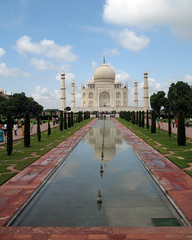

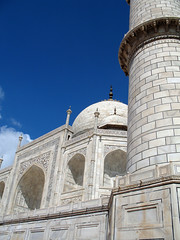
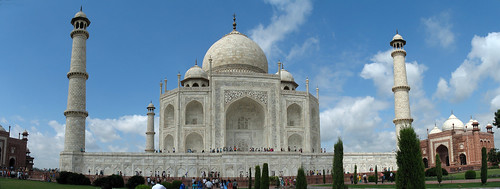
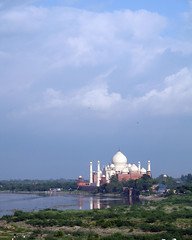
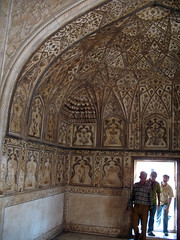
Emma and I left my parents to their guide (you have to give in to them else they will follow you round the whole thing - it's easier just to give them 50p and take their narration). After slowly walking around and through the Taj Mahal the sun had shifted and the monument took on a golden appearance as we headed out. The incredible thing about the Taj Mahal is that it is situated in the middle of an industrial city. In fact, from the Taj View, the Taj appears nestled among towers, chimneys and factories, but when you in the boundaries of the Taj you simply can't see any of that - it's as if the Taj Mahal grounds are surrounded by trees. The view across the river is to the proposed site of the black Taj Mahal that was planned as the mausoleum of Shah Jahan - the man who built the Taj Mahal as a mausoleum to his wife. Unfortunately he was deposed and imprisoned in the nearby Agra Fort by his son. Our trip took us on to the Fort and then back to the hotel for an awesome world-cuisine buffet.
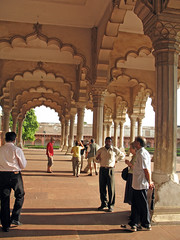
Today was the last day of the Ganpati festival where people took their Ganpatis (idols shaped like Ganesh, the elephant-headed god) and cast them into the sea. This lasted all day with various vans and carts heading towards the sea loaded with clay Ganpatis and whole families. This carried on into the night with bright lights, music and many more firecrackers.
The rest of the week involved getting reacquainted with the city - from the area around the house to downtown. The restaurants, the hanging gardens and Marine Drive and the planetarium (complete with the school tour from hell). Then there was The Club. Every day, my aunt and uncle go to the prestigious Willingdon club where my aunt plays cards and my uncles plays snooker. As a child, we used to go to use the open-air swimming pool. Some years my father actually became a temporary member so we could go more often and children were never allowed in the clubhouse itself. Now I could finally see what all the fuss was about. After a visit to the nearby museum, we arrived for a swim as guests. I haven't swum in years, but it all came back instantly. This time, instead of sitting around the pool afterwards, I was thrilled to finally see the inside of the club. The bar was a modern area with plasma tvs and sweet, sweet air conditioning. Meeting other members of the club reinforces the exclusivity. You may think that a members sports club in a country where many people survive on less than $1 a day would be affordable for a young professional such as myself. I think it's safe to say Emma and I were gob-smacked to find membership cost upwards of £10,000 a year!
One of our tasks for the week was to sort out an excursion. Even though I had been to India many times before, I'd still never been out of the state of Maharashtra. This would change as, combined with the power of the internet and the abundance of low-cost airlines we sorted out a few days in Delhi and Agra.
After experiencing Ryanair, I didn't have high hopes for the Indian variety, but Kingfisher actually puts KLM to shame. New planes, seatback tv screens even on internal flights, good quality food (with metal cutlery) and good crew. Upon arriving in Delhi we were met by our host, my father's nephew Indivar who is an academic at a local university. We piled into his small Tata car and set out across Delhi. After leaving the airport, it immediately became clear that while it was obviously still bonkers, Delhi was a lot less intense and mad than Bombay. The university itself is set in - what to westerners - appears to be a massive amount of wild countryside.
Around Indivar's university-provided accommodation was a family of peacocks, several of which made an appearance. Indivar showed us around the sites, including a Sikh temple and an iron pillar that despite being constructed in 1600-odd years ago hadn't rusted. Sadly, the "magic" reason seems to have been unravelled. We enrolled on an official whistle-stop tour of some sights - including the red fort and Ghandi's tomb that were conducted at break-neck speed.
The trip to Agra would be by train. We had booked first class, but I don't think Emma was ready for what that entailed. As we arrived at the station early in the morning it was already a hive of activity. After finding our platform we discovered it was littered with travellers carrying more baggage that could feasibly fit into the train, hawkers selling their wares and the odd rat running around. As we boarded the train, all thoughts of a western-style first class didn't so much fade from our heads as they were crushed with a mallet. It was like economy on a plane, but without padding on the seats, broken recline mechanisms, tray tables that fell down every five minutes, a lack of A/C and the only entertainment consisted of the sellers that would come through the carriage every so often selling dubious-looking food and drink. After a few hours we arrived in Agra and took a taxi to our hotel for the stay, The Taj hotel. As we entered the hotel, it was like walking into an oasis. Clean white marble, gentle A/C and a good shower. The hotel was called the Taj View and as we reached our room we were happy to discover the hotel lived up to its name.
After an hour or so to enjoy our first decent shower in ten days, we headed back out into the madness and heat to take a rickshaw to the Taj. Rickshaws are awesome fun - it's basically a small moped with a 3-(small) person seat at the back. This means they have the turning circle of a unicycle and combined with the driving discipline meant the we were frequently in danger of falling out as the driver pulled off another ridiculous cornering move.
As we arrived at the drop-off I was amazed that India's best-known tourist attraction and one of the wonders of the modern world can only be accessed by small back streets. We had a few hundred yards to walk through a bazaar full of merchants all of whom didn't seem to want to take no for an answer. As we approached the entrance a new nuisance became evident in the "local tour guides" offering to give us a narrated tour. If you've seen Slumdog Millionaire, this isn't too far from the truth. After paying about 20 times more to enter the grounds than Indians (surely I should have had half off?) we were suddenly in a different world. Yes, there were lots of tourists and their guides, but the oppressiveness of the small streets had given way to a large court yard and as we walked towards the archway the famous view of the gleaming marble shrine came into view. Somehow marble manages to change colour in different lights in a way few other materials can manage. The monument itself seemed to gleam.
Emma and I left my parents to their guide (you have to give in to them else they will follow you round the whole thing - it's easier just to give them 50p and take their narration). After slowly walking around and through the Taj Mahal the sun had shifted and the monument took on a golden appearance as we headed out. The incredible thing about the Taj Mahal is that it is situated in the middle of an industrial city. In fact, from the Taj View, the Taj appears nestled among towers, chimneys and factories, but when you in the boundaries of the Taj you simply can't see any of that - it's as if the Taj Mahal grounds are surrounded by trees. The view across the river is to the proposed site of the black Taj Mahal that was planned as the mausoleum of Shah Jahan - the man who built the Taj Mahal as a mausoleum to his wife. Unfortunately he was deposed and imprisoned in the nearby Agra Fort by his son. Our trip took us on to the Fort and then back to the hotel for an awesome world-cuisine buffet.
Tuesday, October 13, 2009
India part 1
Right, let's try and get this blog back on track. The first big update from just over a year ago(!) was the trip Emma and I took with my family to India. I used to go for 3 or 4 weeks every year until I was 14. This means it had been 14 years since the last visit. My parents had been a couple of times in recent times and I had been reliably informed that everything had changed in Bombay (sorry - I don't call it Mumbai, much like it's residents) and it had become much more Westernised. Thus I approached it with an open mind whilst recollecting the madness I remembered and Emma had no idea what was coming. My parents flew out a week before us (and it rained every day that week), so our trip began at 5am on a Saturday morning when our taxi arrived to take us to Birmingham airport. The "Eurohub" looks a bit sorry for itself these days and BA have fully abandoned Birmingham. We were soon on the KLM flight to Amrsterdam which was even quicker than from Newcastle, although Emma was developing a reaction to her new contact lenses rendering her partially blind for the day. This did facilitate hiding the madness later on. Our flight on to Bombay was with KLM's partner NWA (which always makes me laugh) and before we were allowed on the plane, everyone was taken to a table with their party and asked further security questions - talk about paranoia - the plane wasn't even going anywhere near the US. The flight passed fairly quickly (~9 hours) and we were soon descending over the sea towards Bombay. If the city had modernised, then they still hadn't cleared the slums from the airport perimeter. It still seems very surprising that we were really scrutinised before being allowed anywhere near a plane, yet there is a shanty town that could house anyone and anything is right up to the airport perimeter fence. As predicted, despite pleas to remain seated until the plane had come to a standstill at the terminal, most of the Indian contingent of the flight was up out of their seats trying to unload their baggage from the overhead bins almost as soon as the plane was off the runway. As we left the plane that nostalgically familiar heat wave hit me straight in the face. As we got to the terminal, nothing much seemed to have changed - they still seemed to be rebuilding the terminal and there was the familiar feeling that absolute chaos was only seconds away. Baggage collection led to at least a couple of people learning why you shouldn't stand close to the luggage belt unless you're retrieving bags as one traveller strugled to remove a case just large enough to hold a full-grown elephant, the momentum of the belt took it straight into a couple of unsuspecting punters standing nearby - the first of which got it straight in the crotch. Whilst I tried to keep a straight face, I saw out bags and we were away. My parents had arrived with a driver to take us back to the house in Dadar and even though it was just about midnight, there was a hot and heavy atmosphere (and a LOT of people milling around). We were led to the large car that would take us back and as we piled in, the rain began. We had inadvertently arrived at the end of the Ganpati festival and the roads were strewn with fairy lights and people on the streets. Emma was still suffering from a lack of long distance vision, so she was eased into the bonkers visuals. The main problem in Bombay is that there are far too many people. This is evidenced by the scores of people milling into the roads as there is no room on the pavements. Within minutes the first "change" revealed itself - the roads which were washed away in the recent floods had been "temporarily" rebuilt with bricks rather than tarmac. I suspect they're going to be in place until they too are washed away. The first beneficial change I noticed was the construction of flyovers on the highway which negated the need for traffic lights every few hundred metres.
It's remarkable how much more things seem complicated as you grow up. When I was younger I used to just sit in the cars and look at the sites. Now I am a qualified driver I sat open mouthed at the standard of driving which I will attempt to describe. There are (or, were) lane markings that are completely ignored - if a car fits into a space, it will. Red traffic lights seem to be considered as optional - which is something I don't remember from before. The cars are an eclectic mix of the old (Fiats and Ambassadors), old-ish (Suzuki Marutis) and modern Tata and East Asian cars. The majority of them don't have wing mirrors. For the older cars, this was a design "feature", for newer cars, they likely didn't survive the drive home from the garage. Given the tight packing that drivers seem to favour, there is a matter of centimetres between vehicles. That lack of spacial awareness is compensated for by the horn. If you approach a vehicle from behind - you blow your horn to let the driver know you are there. As you overtake a vehicle, you blow your horn to make sure the driver doesn't pull into you. If the driver is slightly slow at pulling away from a traffic light, you blow your horn. If the day of the week has an "a" in it, you blow your horn. And for added amusement, sounding your horn is illegal. If you very go to India and consider hiring a car, just don't. Someone who actually learned to drive using mirrors wouldn't survive 10 minutes.
Anyway, we arrived in Dadar after about 30 minutes and I met my Aunt and Uncle who I hadn't seen since 1996. The house was built by my Grandfather and is a 3-storey building. My memories of it were that my uncle's parents lived on the bottom floor, my aunt and uncle (and us when we were there) lived on the first floor and my grandparents lived on the top floor. The house was in need of refurbishing back in the 80s and I remember sitting on the stairs peeling paint off the walls (something that was sooooo satisfying to do when you got a big piece off) and it hasn't been touched up since. Due to deaths it's now just my aunt and uncle there now along with the servants. The crazy thing with the servants is how they live. They sleep on the floor in the kitchen (even though they must be in at least their 40s and there are several unoccupied beds), they have an outhouse toilet (even though there are 3 toilets in the house), they hand-scrub the washing (even though there is a washing machine) and they are expected to do the shopping and cook all the food. One of the servants actually left to go and work in a textile mill, but came back because his life was better as a servant.
Anyway, I've typed for a long time and still only described up to the first night. I'll try to be more concise in the next parts.
Sunday, February 22, 2009
The AppleTV
It started last summer when I was sitting around talking with some friends about what a pain a large media collection is. With music - a lot of people have migrated over to mp3 and I have to say that with a decent ripper (EAC) and compressing to 192 kbps VBR I struggle to tell the difference between the mp3 and the CD - I can tell there is a difference, but can't tell which is better. This means my CDs can be stored somewhere in a big box. Someday I'd like to go back and re-rip them to FLAC or some other lossless file to have a perfect digital copy for archival purposes. The trouble is DVDs. Initially, having a big collection was something to be proud of, but as I've moved around, transporting all my disks was starting to be a handful. Unfortunately, unlike CDs, a full DVD rip would take up 6-8 GB per disk, and at a collection of some 300 discs, that can add up. We talked about how there should be a way to have your DVDs on a hard disc allowing you to box up the discs in long term storage. I didn't know it then, but such a solution already existed. When Apple launched the AppleTV it flopped. They tried again with updated software and the response was still tepid. Then came tools such as Handbrake, which allowed you to compress films down. DVDs are encoded in MPEG2 which was developed in the early 90s so the technology looks pretty ancient today. The modern Blu-Ray discs tend to be encoded using something called H.264 which is much more efficient and allows you to get the same quality from a smaller file. Thus, using Handbrake it's possible to extract and compress down a 6-7 GB DVD film to a 1-2 GB mp4/m4v file. This file can then be "tagged" with metadata in the same way an mp3 file can using tools such as MetaX (mac/windows). It can retain multiple audio tracks (except DTS for now) so you still got 5.1 sound out and this can then be copied over to the AppleTV or streamed.

There are a few problems.
Firstly, this normally just preserves the film. There are no menus or extras (unless you rip the extras too). In theory I don't mind cos I normally only watch the extras once. Also, some discs with seamless branching have to have each version of the film encoded separately
Secondly, some of the tools (for example Subler to insert subtitles) are still Mac-only
Thirdly, Apple still only sells the aTV with a maximum drive of 160 GB. They also use old-styl drives so the maximum you can upgrade it to is 320 GB, so big collections still won't fit, and Apple still insists you can only stream stuff via iTunes which needs a PC on running iTunes. There are ways around this, such as using hacks to install things like XBMC which can stream from network hard drives.
Right now I've got all my music and most of my TV show DVDs stored on my aTV with my non-DTS films available to stream when my PC is on. I can see why Apple don't put large hard drives in the aTV - so you can copy music to it and use a bit of storage for rentals/buffering and rely on streaming from a large hard drive somewhere for videos - but I don't understand why they won't move away from requiring a PC to be on with iTunes running to do it. I'm hoping the next year will bring some solutions allowing me to rip my DTS films which will reduces the physical size of my collection. We are slowly creeping towards a total digital solution with books, papers, photos and films stored on "cheap" storage and kept in small boxes that can be connected to the internet allowing us access to our data anywhere in the world we can get a connection to the internet. I say, bring it on!
Foreign Conferences
In 2008 I got to go to two international conferences. the first, in July, was the Fpi8 conference in Graz, Austria. The FPi series alternates between Europe, the US and Japan and Fpi8 marked my attendance of the complete set - Ithaca 2004, Osaka 2006 and now Graz. I was going with Martin, Mustafa and Pete from Chemistry and Torsten from CDT. While the others opted to fly down to Stansted and then out to graz, I thought of my FlyingBlue miles and flew to Austria via Amsterdam and then got the train to Graz. Both options turned out to work well and by the end of the Sunday we were all sitting down to a large Austrian meal under a large canvas roof. Soon, the rain developed into a full blown storm which made sitting outside interesting.
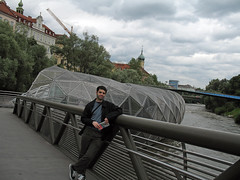
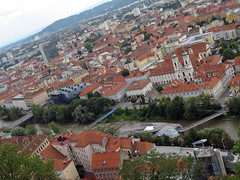
The difference between this and other conferences I had been to was that this time I was making an oral presentation rather than just defending a poster. Before that though I sat through 4 days of talks on functionalised pi-systems. Since Ithaca, academic interest has shifted from OLED materials to transistors (OTFT) and solar cells (OPV). Infact, most OELD talks were towards the end of the conference. The talk went well, even though I was introduced as "mister" grrr. The first one is supposed to be the hardest, so that boded well for the next conference. Instead of going on the organised excursions, Pete and I wandered around graz - which is a fairly small city - taking in all the sites from the weird "alien" buildings of the culture centre and the river-slug to the Schlossberg and clocktower that overlooks the city (taking the hillside train was a much better option than walking).
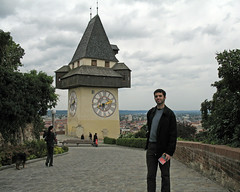
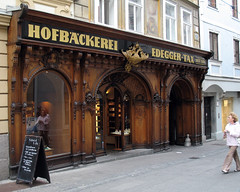
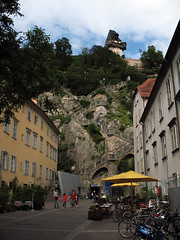
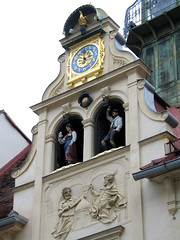
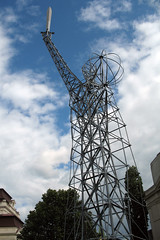
The second conference was at the start of September in Dresden. This time I was the only chemist in our visiting party made up of Andy, Olivier, Ben and mot of Andy's Ph.D. students. A flight via Dusseldorf left us in the tiny Dresden airport trying to figure out the ticket machine. It ended up stumping us. Our hotel was next to the train station and, apart from registering at the conference site, out first day and a half was free so we made good use of it wandering around the reconstructed Dresden.
Unlike blitzed cities in the UK, Dresden took a long time to be rebuilt and the extra care that's gone into it is evident - the buildings have been rebuilt to maintain a traditional feel rather than just throw up concrete buildings like we did. The end result is a much more pleasant cities than somewhere like Coventry.
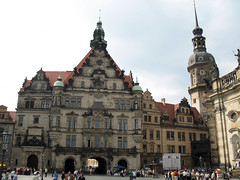
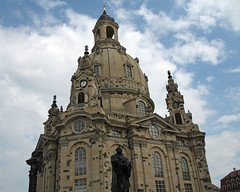
A with Austria we enjoyed some excellent food - and took advantage of Andy's knowledge and contacts to get to some restaurants most tourists wouldn't including a Thai restaurant on the edge of the city and a chicken restaurant. The conference ws solely focussed on OLEDs with an emphasis on device physics and engineering, but there was still a bit of chemistry. The session my talk was in lost most of it's participants as the first 2 of 4 speakers hadn't shown up, but some of the audience had returned for my talk - which was a more complete version of the one from Graz. A Special mention has to go to the conference banquet which had some awesome food on offer, including the very moreish veal slices... Hopefully 2009 will bring a few more conferences my way.
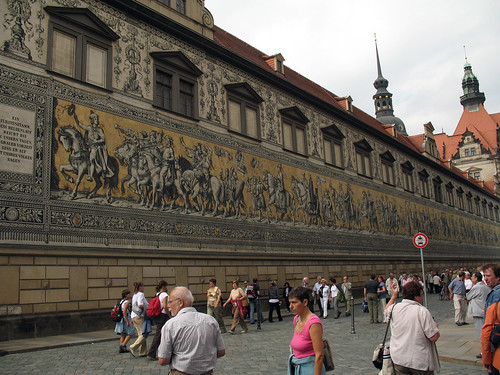
The difference between this and other conferences I had been to was that this time I was making an oral presentation rather than just defending a poster. Before that though I sat through 4 days of talks on functionalised pi-systems. Since Ithaca, academic interest has shifted from OLED materials to transistors (OTFT) and solar cells (OPV). Infact, most OELD talks were towards the end of the conference. The talk went well, even though I was introduced as "mister" grrr. The first one is supposed to be the hardest, so that boded well for the next conference. Instead of going on the organised excursions, Pete and I wandered around graz - which is a fairly small city - taking in all the sites from the weird "alien" buildings of the culture centre and the river-slug to the Schlossberg and clocktower that overlooks the city (taking the hillside train was a much better option than walking).
The second conference was at the start of September in Dresden. This time I was the only chemist in our visiting party made up of Andy, Olivier, Ben and mot of Andy's Ph.D. students. A flight via Dusseldorf left us in the tiny Dresden airport trying to figure out the ticket machine. It ended up stumping us. Our hotel was next to the train station and, apart from registering at the conference site, out first day and a half was free so we made good use of it wandering around the reconstructed Dresden.
Unlike blitzed cities in the UK, Dresden took a long time to be rebuilt and the extra care that's gone into it is evident - the buildings have been rebuilt to maintain a traditional feel rather than just throw up concrete buildings like we did. The end result is a much more pleasant cities than somewhere like Coventry.
A with Austria we enjoyed some excellent food - and took advantage of Andy's knowledge and contacts to get to some restaurants most tourists wouldn't including a Thai restaurant on the edge of the city and a chicken restaurant. The conference ws solely focussed on OLEDs with an emphasis on device physics and engineering, but there was still a bit of chemistry. The session my talk was in lost most of it's participants as the first 2 of 4 speakers hadn't shown up, but some of the audience had returned for my talk - which was a more complete version of the one from Graz. A Special mention has to go to the conference banquet which had some awesome food on offer, including the very moreish veal slices... Hopefully 2009 will bring a few more conferences my way.
Two Weddings
In an effort to get the rest of last year blogged, here are a couple of big events from 2008. The first was the Wedding of college friends Matt and Mel in Melbourne near Derby. A group of us from Durham drove down on the Friday night to the East Midlands' Airport Travelodge (actually built into the service station). Luckily, our room didn't overlook the Burger King. Not only was I a wedding guest, but I had also agreed to act as one of the two photographers for the day. When we rolled up to the church I was handed a d-SLR and some memory cards and had a few minutes to get used to how it worked and figure out the different shooting modes before I was off taking pictures of the area and guests. I won't go on about the ceremony as I'll just post some pictures (more on my Flickr site). I will say that as a photographer I didn't get the chance to relax and chill out until the meal, after which I handed over the camera and became just a guest again. Of the hundreds of shots Caz and I took, a lot turned out really well which I'm happy about.
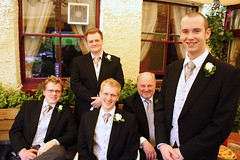
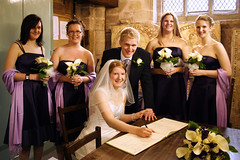
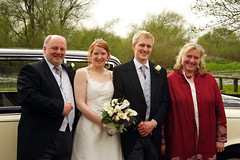

The second wedding was over the summer in Durham and saw Alan and Lucy get married. This time I was involved as an usher which simply involved shepherding guests around at the church and then the reception. This time it was a pretty miserable day with rain and drizzle throughout the ceremony. As we arrived at St Mary's College for the reception the sun broke out and the afternoon and evening was very sunny and warm so the drinks reception took place outside. Again, more pictures are on Flickr.
The second wedding was over the summer in Durham and saw Alan and Lucy get married. This time I was involved as an usher which simply involved shepherding guests around at the church and then the reception. This time it was a pretty miserable day with rain and drizzle throughout the ceremony. As we arrived at St Mary's College for the reception the sun broke out and the afternoon and evening was very sunny and warm so the drinks reception took place outside. Again, more pictures are on Flickr.
Subscribe to:
Posts (Atom)
